1. Blog
  2. Article

Canonical
on 11 March 2015
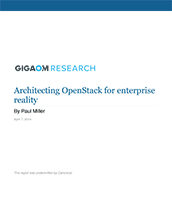
Architecting OpenStack for enterprise reality


With OpenStack becoming more and more popular as a cloud-building technology for enterprises, companies are asking themselves several important questions. How viable is OpenStack as an enterprise platform? Is it possible (and feasible) to integrate it with existing virtualisation infrastructure, e.g. vSphere from VMware? Is there a business case for such integration, and what are the risks and challenges associated with it? Finally, how do they best utilise OpenStack: is the “vanilla” architecture always the best approach, or is there a case for swapping out certain components for third-party tools?

Gigaom analyst Paul Miller looks at these questions and more in this report sponsored by Canonical. For a more in-depth look at integrating vSphere and OpenStack, you may also want to read this whitepaper.
Download eBook

Related posts


Massimiliano Gori
31 March 2026

How to manage Ubuntu fleets using on-premises Active Directory and ADSys

Cloud and server Article

The “hybrid fleet” is today’s reality: organizations diversify operating systems while Microsoft Active Directory (AD) remains the dominant identity “source of truth.” IT administrators must ensure Linux machines, like Ubuntu desktops and servers, behave as first-class citizens in this environment. Efficient Linux management demands unifi ...


David Beamonte
30 March 2026

Simplify bare metal operations for sovereign clouds

MAAS Article

The way enterprises are thinking about their infrastructure has changed.  Digital sovereignty of all kinds – data sovereignty, operational sovereignty, and software sovereignty – have begun to dominate the infrastructure discussion. Today, these abstract terms have become practical concerns for platform teams. Changing regulations, geopol ...


Massimiliano Gori
30 March 2026

How to Harden Ubuntu SSH: From static keys to cloud identity

Cloud and server Article

30 years after its introduction, Secure Shell (SSH) remains the ubiquitous gateway for administration, making it a primary target for brute force attacks and lateral movement within enterprise environments. For system administrators and security architects operating under the weight of regulatory frameworks like SOC2, HIPAA, and PCI-DSS, ...